Full business revitalization for a college DTC hat brand.
Custom Shopify storefront, B2B wholesale system, brand collateral, and a growth plan. Replaced ~$1,500/year in paid Shopify extensions with custom code.
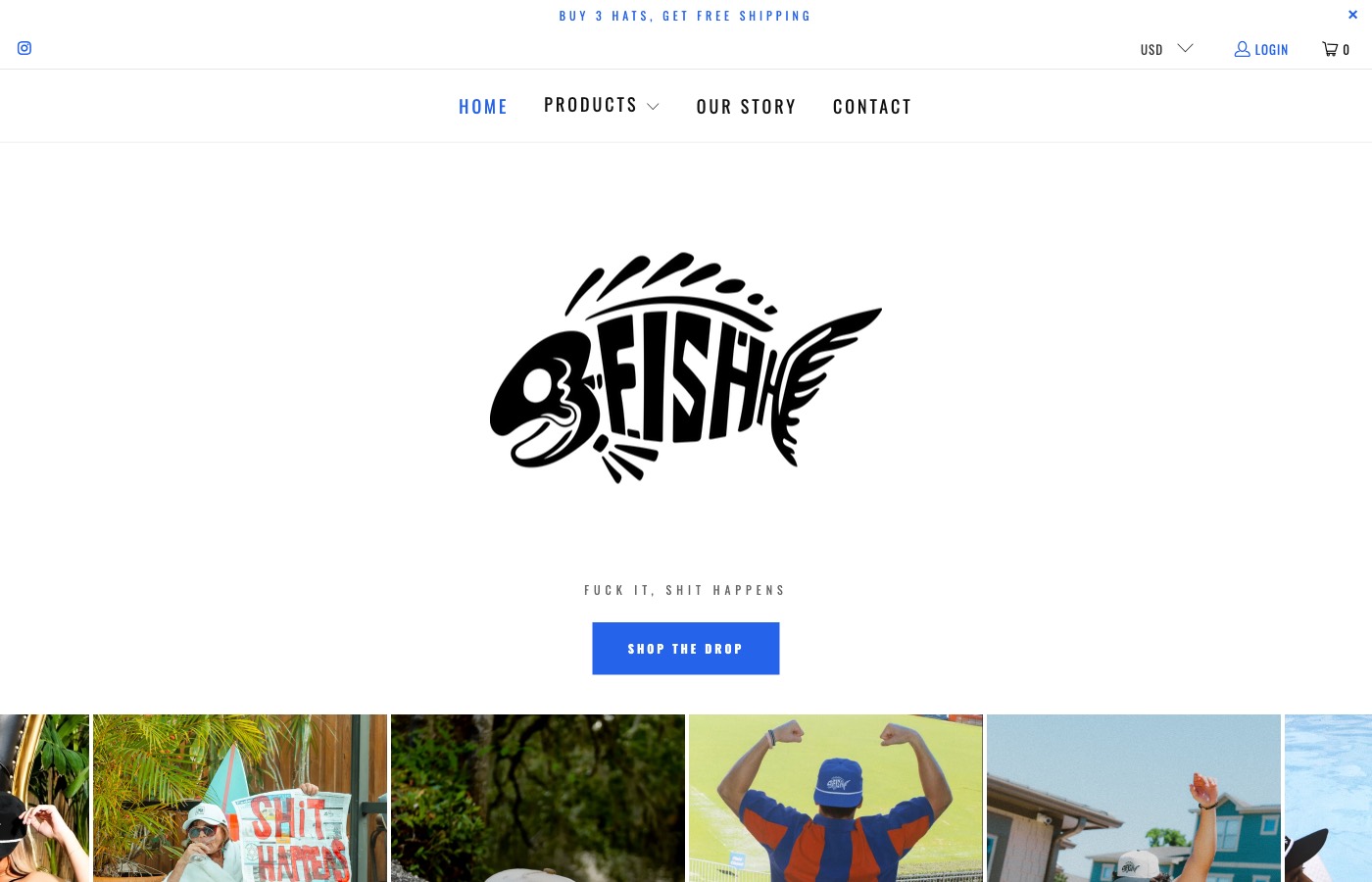
Took a college DTC hat brand from “paying for everything off the shelf” to a custom-engineered commercial surface: Shopify storefront, B2B wholesale system, brand collateral, and a 12-month growth plan. About $1,500/year in paid Shopify extensions replaced with custom code that ships with the theme.
The problem
FISH Apparel (acronym aside, Fuck It, Shit Happens) is a Gainesville-based college hat brand selling at retail and through wholesale partnerships with bars, marinas, and college nightlife venues. The brand had a Shopify store, a name, and momentum. What it didn’t have was the infrastructure to operate at scale.
Specifically:
- The product gallery shipped wrong photos for the selected color variant, a checkout-killer for a brand whose product variants are the entire pitch (Gator orange, Seminole garnet, and so on). The store was paying $14.90/month for a Shopify app to fix it.
- No wholesale channel at all. Retail partners (bars, marinas, college venues) would email orders manually. There was no real catalog, no pricing structure, no contact flow.
- No checkout incentive to add a third hat, even though the brand’s economics work much better at the 3-hat threshold.
- Inconsistent brand collateral. Business cards, email signatures, social posts: none of them looked like the same business.
- Product copy that read like dropdown options, not like the brand’s actual voice.
The brand needed fewer app subscriptions and more infrastructure. This was a rebuild of how the business operated commercially, not a redesign of how it looked.
What we built
A storefront that shows the right product
Customers picking a color variant now see only the photos that match that color. The free-shipping progress bar visibly nudges them toward the 3-hat threshold. The cart page surfaces one-click add for impulse purchases instead of forcing customers through a longer flow. The mega menu shows live products instead of static category links. All of this without a single paid Shopify app. Every feature is custom code that lives in the theme.
A working wholesale channel where there wasn’t one
Retail partners now have a dedicated wholesale portal. Each partner gets access via a QR code on their business card. They scan it and land directly inside the authenticated catalog, no password entry required. Orders go through a structured form with quantity selectors and real-time totals. The order arrives in the brand’s inbox already scoped for fulfillment. Before this engagement, the wholesale channel was emails and screenshots. Now it’s a real funnel.
Product copy rewritten across the entire catalog
Every product page got a full rewrite, not just the names. Every paragraph. The previous copy read like Shopify variant labels: color, size, fabric, repeat. The new copy talks like the brand actually talks. Each hat is tied to its context (game-day, beach day, after-party), references the specific moments the brand sells into, and matches the tone of its social presence. Product pages stopped feeling like a spreadsheet and started feeling like the brand itself. That’s the difference between a customer landing on a page and bouncing vs. landing on a page and adding to cart.
A coherent set of brand collateral
- Business cards. Multiple design directions, toggleable per team member, with QR codes that drop B2B prospects directly into the wholesale portal. Plus a complete printing guide so the team can order new cards without needing a designer in the loop.
- Email signatures. Branded, consistent across the team, using the brand fonts and color system.
- Social link previews. Link shares on iMessage, LinkedIn, and Slack now render a branded preview card instead of nothing.
Before, every printed thing looked like it came from a different company. After, it’s one brand.
A full social media strategy and campaign plan
The growth work was the largest non-code piece of the engagement. The brand didn’t just need a website that converts. It needed a written social media strategy and a campaign playbook the team can run for the next twelve months without inventing each week from scratch.
Posting strategy. A platform-by-platform cadence with explicit content-mix targets: product shots, lifestyle and UGC, behind-the-scenes, partnership posts, game-day reposts. Instagram-heavy with a TikTok plan for short-form moments, plus caption templates the team can adapt. The team stops asking “what should we post today?” each morning.
Five UGC campaigns, end to end. Each campaign has a defined hook, the customer offer, the content ask (what the customer shoots and how), the hashtag system, and an expected lift timeframe. These aren’t generic “tag us and you might win something” prompts. They’re specific seasonal plays tied to FISH’s actual moments: game-day reposts, marina partner takeovers, after-the-game reactions, college-night activations. The team can launch them on a schedule.
Ad budget allocation. A monthly spend broken down across cold acquisition (lookalikes), retargeting (warm audiences who visited the site), and partner-amplified content. Each channel has a target CPA derived from FISH’s real margin and AOV, so the team knows when to scale spend and when to cut a campaign.
B2B partnership pipeline. Active relationships with bar groups, marina operators, and hospitality partners are tracked alongside a written pipeline of next-target partners. The plan covers what to ask each one for, what to offer, and how to measure whether a partnership is actually producing.
AI content production at small-brand scale. A practical playbook for using modern AI video and image tools to produce more brand content without hiring a content team: what’s worth the effort, what to skip, and how to keep the output on-brand.
The output isn’t a slide deck that sits unread. It’s a four-tab interactive report the team can update as campaigns ship and the pipeline moves.
Native newsletter capture
What would normally be a paid Klaviyo subscription (about $30/month at 1,000 contacts) is now a homepage section that sends signups directly into the Shopify customer list. Same lead capture, no monthly fee.
Outcome
- About $1,500/year in paid Shopify extensions replaced with custom code that ships in the theme. One-time engagement cost, permanent savings.
- A B2B funnel where there wasn’t one. Retail partners now self-serve on a real catalog, and structured orders arrive ready to fulfill.
- AOV mechanic built into checkout. The “Add X for free shipping” progress bar pushes customers toward the 3-hat threshold where the brand makes money.
- Product pages that sell, not just list. The full copy rewrite shifted product detail pages from feeling like a catalog to feeling like the brand.
- A coherent commercial identity across storefront, business cards, email, and social. All reading as one brand instead of a stack of one-off pieces.
- A growth plan in writing. The team has a shared roadmap instead of improvising weekly.